17 July 2021
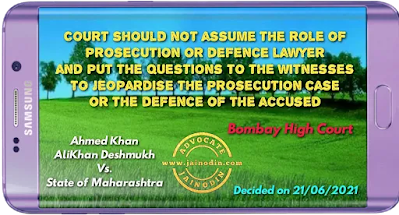
Court should not assume the role of prosecution or defence lawyer and put the questions to the witnesses to jeopardise the prosecution case or the defence of the accused

13 July 2021
For proving the offence of forgery u/s.465 of IPC, it must be proved as to who did it
23 June 2021
voluntary presents given at or before or after the marriage to the bride or the bridegroom, out of love and affection is not dowry
19 June 2021
Continuous and consensual sex between two adults cannot be considered as Rape
15 June 2021
After lapse of previous rent agreement if fresh rent agreement is not created, then the landlord can recover last payable rent but not the enhanced rent
28 May 2021
Misuse and or abuse of powers by public servant is not a part of their official duties so no protection u/s.197 of CrPC is available
If the authority vested in a public servant is misused for doing things which are not otherwise permitted under the law, such acts cannot claim the protection of Section 197 Cr.P.C.
30 April 2021
When counsel reports no instructions, it is the duty of the Court to issue notice to the party concerned before proceeding further in the matter
Every litigant ought to be afforded an opportunity of deciding the issue involved on merits without the same being scuttled on mere technicalities
29 April 2021
Cr.P.C. does not provide any provision for service of summons through Whatsapp
Going by Section 65 of Cr.P.C, if service could not be effected as provided under Section 62, the serving officer shall affix one of the duplicates of the summons to the conspicuous part of the house or homestead in which the person summoned ordinarily resides. Thereafter, the court should make such enquiries as it thinks fit and either declare the summons to have been duly served or order fresh service in such manner as it considers proper. As per Rule 7 of the Criminal Rules of Practice, Kerala, summons issued to the accused and witnesses shall ordinarily be signed by the Chief Ministerial Officer of the Court and the words “By order of the Court” shall invariably be prefixed to the signature of the Ministerial Officer. [Para No.3]
Judicial discretion cannot be so liberally exercised as to condone the delay where no cause is made out or the cause ascribed is unworthy of acceptance
The sufficient cause should be such as it would persuade the Court, in exercise of its judicial discretion, to treat the delay as an excusable one
“32. It must be kept in mind that whenever a law is enacted by the legislature, it is intended to be enforced in its proper perspective. It is an equally settled principle of law that the provisions of a statute, including every word, have to be given full effect, keeping the legislative intent in mind, in order to ensure that the projected object is achieved. In other words, no provisions can be treated to have been enacted purposelessly.Furthermore, it is also a well settled canon of interpretative jurisprudence thatthe Court should not give such an interpretation to the provisions which would render the provision ineffective or odious. Once the legislature has enacted the provisions of Order 22, with particular reference to Rule 9, and the provisions of the Limitation Act are applied to the entertainment of such an application, all these provisions have to be given their true and correct meaning and must be applied wherever called for.If we accept the contention of the Learned Counsel appearing for the applicant that the Court should take a very liberal approach and interpret these provisions (Order 22 Rule 9 CPC and Section 5 of the Limitation Act) in such a manner and so liberally, irrespective of the period of delay, it would amount to practically rendering all these provisions redundant and inoperative. Such approach or interpretation would hardly be permissible in law. 34.Liberal construction of the expression ‘sufficient cause' is intended to advance substantial justice which itself presupposes no negligence or inaction on the part of the applicant, to whom want of bona fide is imputable. There can be instances where the Court should condone the delay; equally there would be cases where the Court must exercise its discretion against the applicant for want of any of these ingredients or where it does not reflect “sufficient cause” as understood in law. (Advanced Law Lexicon, P. Ramanatha Aiyar, 2nd Edition 1997).35. The expression “sufficient cause” implies the presence of legal and adequate reasons. The word “sufficient” means adequate enough, as much as may be necessary to answer the purpose intended. It embraces no more than that which provides a plentitude which, when done, suffices to accomplish the purpose intended in the light of existing circumstances and when viewed from the reasonable standard of practical and cautious men.The sufficient cause should be such as it would persuade the Court, in exercise of its judicial discretion, to treat the delay as an excusable one. These provisions give the Courts enough power and discretion to apply a law in a meaningful manner, while assuring that the purpose of enacting such a law does not stand frustrated.36…………………………………………………………….37…………………………………………………………….38. Above are the principles which should control the exercise of judicial discretion vested in the Court under these provisions. The explained delay should be clearly understood in contradistinction to inordinate unexplained delay.Delay is just one of the ingredients which has to be considered by the Court. In addition to this,the Court must also take into account the conduct of the parties, bona fide reasons for condonation of delay and whether such delay could easily be avoided by the applicant acting with normal care and caution. The statutory provisions mandate that applications for condonation of delay and applications belatedly filed beyond the prescribed period of limitation for bringing the legal representatives on record, should be rejected unless sufficient cause is shown for condonation of delay. The larger benches as well as equi-benches of this Court have consistently followed these principles and have either allowed or declined to condone the delay in filing such applications. Thus, it is the requirement of law that these applications cannot be allowed as a matter of right and even in a routine manner. An applicant must essentially satisfy the above stated ingredients; then alone the Court would be inclined to condone the delay in the filing of such applications.”[Para No.18]
25 April 2021
No contract employee has any vested right to continue or to have his or her contract renewed
6.It is settled law that no contract employee has a right to have his or her contract renewed from time to time. That being so, we are in agreement with the Central Administrative Tribunal and the High Court that the petitioner was unable to show any statutory or other right to have his contract extended beyond 30th June, 2010. At best, the petitioner could claim that the concerned authorities should consider extending his contract. We find that in fact due consideration was given to this and in spite of a favourable recommendation having been made, the All India Institute of Medical Sciences did not find it appropriate or necessary to continue with his services on a contractual basis. We do not find any arbitrariness in the view taken by the concerned authorities and therefore reject this contention of the petitioner.7. We are also in agreement with the view expressed by the Central Administrative Tribunal and the High Court that the petitioner is not entitled to the benefit of the decision of this Court in Uma Devi. There is nothing on record to indicate that the appointment of the petitioner on a contractual basis or on an ad hoc basis was made in accordance with any regular procedure or by following the necessary rules. That being so, no right accrues in favour of the petitioner for regularisation of his services. The decision in Uma Devi does not advance the case of the petitioner.8. Insofar as the final submission of the petitioner to the effect that some persons were appointed as Technical Assistant (ENT) in May 2016 is concerned, we are of the view that the events of 2016 cannot relate back to the events of 2010 when a decision was taken by the All India Institute of Medical Sciences not to extend the contract of the petitioner. The situation appears to have changed over the last six years and the petitioner cannot take any advantage of the changed situation. There is no material on record to indicate what caused the change in circumstances, and merely because there was a change in circumstances, does not mean that the petitioner is entitled to any benefit. On the other hand, it might have been more appropriate for the petitioner to have participated in the walk in interview so that he could also be considered for appointment as Technical Assistant (ENT), but he chose not to do so.
24 April 2021
Even illegally obtained document is admissible in evidence if it is relevant and genuine one
22 April 2021
Non-production/withholding a vital document in order to gain an advantage on the other side tantamounts to playing fraud on the Court
No litigant is entitled to obtain the aid of the law to protect him in carrying out a fraudulent act
19 April 2021
Testamentary disposition by Will is not a 'transfer' as defined u/s.5 of the Transfer of Property Act
It is not necessary to obtain a probate in respect of properties which are not situated whithin the ordinary original civil jurisdiction of the High Courts of Judicature at Madras and Bombay
11 April 2021
Death caused; without any premeditation, in a sudden fight, in the heat of passion, without taking any undue advantage or acted in a cruel or unusual manner, is not a murder
"19. Consequently, we are convinced thatsince the death of Suraj Mal and Shri Ram had occurred due to the firing resorted to as part of his self-defence, the same would amount to culpable homicide not amounting to murder, which was committed without any premeditation in a sudden fight in the heat of passionupon a sudden quarrel and that the offender did not take undue advantage or acted in a cruel or unusual manner, which would normally fall under Exception 4 of Section 300 IPC. Consequently, at best, conviction of the appellant can only be under Part II of Section 304 IPC for which he could have been inflicted with a punishment of ten years. For the very same reason, the conviction imposed under Section 27 of the Arms Act cannot also be sustained. It is stated that the appellant is suffering the sentence in jail and has so far suffered eleven years. The conviction is modified into one under Section 304 Part II and the sentence already suffered by the appellant is held to be more than sufficient."[Para No.29]
06 April 2021
It is appropriate case for grant of anticipatory bail when F.I.R. is lodged by way of counterblast to an earlier F.I.R lodged/complaint filed by the accused against the informant in near proximity of time
16 March 2021
Signed carbon copy prepared in the same process as the original document assumes the character of the original document
13 March 2021
Availability of civil or arbitral remedy for breach of contract, does not mean that initiation of criminal proceedings will be an abuse of the process
12 March 2021
Trial Judge has to seek explanation from the advocate orally while deciding the relevancy of question asked in cross examination rather than entirely putting the shutter down while disallowing of the questions
"No doubtcross-examination is one of the most important processes for the elucidation of the facts of a case and all reasonable latitude should be allowed, but the Judge has always a discretion as to how far it may go or how long it may continue. A fair and reasonable exercise of his discretion by the Judge will not generally be questioned".[Para No.14]
11 March 2021
Statement of witness recorded u/s.164 of Cr.P.C. is not substantial evidence
"In making the above and similar comments the trial Court again ignored a fundamental rule of criminaljurisprudence thata statement of a witness recorded under S. 164, Cr.P.C. , cannot be used as substantive evidence and can be used only for the purpose of contradicting or corroborating him. "[Para No.69]
"15. So far as the statement of witnesses recorded under Section 164 is concerned, the object is two fold; in the first place, to deter the witness from changing his stand by denying the contents of his previously recorded statement, and secondly, to tide over immunity from prosecution by the witness under Section 164. A proposition to the effect that if a statement of a witness is recorded under Section 164, his evidence in Court should be discarded, is not at all warranted. (Vide: Jogendra Nahak & Ors. v. State of Orissa & Ors., AIR 1999 SC 2565: (1999 AIR SCW 2736); and Assistant Collector of Central Excise, Rajamundry v. Duncan Agro Industries Ltd. & Ors., AIR 2000 SC 2901) : (2000 Air SCW 3150).
08 March 2021
Judgment in cross/counter cases must be pronounced by the same judge one after the other in the same day
"2. We think that the fair procedure to adopt in a matter like the present where there are cross cases, is to direct thatthe same learned Judge must try both the cross cases one after the other. After the recording of evidence in one case is completed, he must hear the arguments but he must reserve the judgment. Thereafter he must proceed to hear the cross case and after recording all the evidence he must hear the arguments but reserve the judgment in that case. The same learned Judge must thereafter dispose of the matters by two separate judgments. In deciding each of the cases, he can rely only on the evidence recorded in that particular case. The evidence recorded in the cross case cannot be looked into. Nor can the judge be influenced by whatever is argued in the cross case. Each case must be decided on the basis of the evidence which has been placed on record in that particular case without being influenced in any manner by the evidence or arguments urged in the cross case. But both the judgments must be pronounced by the same learned Judge one after the other" [Para No.9]
"12. How to implement the said scheme in a situation where one of the two cases (relating to the same incident) is charge-sheeted or complained of, involves offences or offence exclusively triable by a Court of Sessions, but none of the offences involved in the other case is exclusively triable by the Sessions Court. The Magistrate before whom the former case reaches has no escape from committing the case to the Sessions Court as provided in Section 209 of the Code. Once the said case is committed to the Sessions Court, thereafter it is governed by the provisions subsumed in Chapter XVIII of the Code. Though, the next case cannot be committed in accordance with Section 209 of the Code, the Magistrate has, nevertheless, power to commit the case to the Court of Sessions, albeit none of the offences involved therein is exclusively triable by the Sessions Court. Section 323 is incorporated in the Code to meet similar cases also. That section reads thus:
"323.If, in any inquiry into an offence or a trial before a Magistrate, it appears to him at any stage of the proceedings before signing judgment that the case is one which ought to be tried by the Court of Session, he shall commit it to that Court under the provisions hereinbefore contained and thereupon the provisions of chapter XVIII shall apply to the commitment so made."